Zuletzt aktualisiert am 17. July 2026
You make slime without a shop-bought activator by mixing white PVA glue with a mild household bonding agent, such as contact lens solution containing boric acid, plus a little baking soda. This activator-free method costs about £1 and takes roughly five minutes.
Reviewed July 2026. Activator-free slime swaps borax for everyday alternatives. The core recipe combines white PVA glue, half a teaspoon of baking soda and two to three tablespoons of contact lens solution that lists boric acid. For a genuinely borax-free version, mix shampoo with cornflour instead. Both methods produce a stretchy, non-Newtonian material in under ten minutes, cost roughly £1 per batch and keep for about a week in an airtight container. Adult supervision is essential for younger children.
What does “slime without activator” actually mean?
Slime without activator means slime made without borax powder or branded slime activators. The method uses milder bonding agents — contact lens solution, baking soda and liquid starch — that react with polyvinyl alcohol in PVA glue to form a stretchy, cross-linked polymer.
PVA glue (polyvinyl acetate school glue) supplies long polymer chains. A bonding agent then links those chains together, turning a runny liquid into a cohesive mass. Borax (sodium tetraborate) is the traditional cross-linker, but its boron content is the reason many UK parents avoid it.
Contact lens solution replaces borax because it contains boric acid and sodium borate in far smaller, buffered quantities. Baking soda (sodium bicarbonate) fine-tunes the reaction and firms the final texture. Read the label first: only saline marked with boric acid will set slime, which is why plain “sensitive eyes” saline fails.
Finished slime is a non-Newtonian fluid — a material whose thickness changes with the force applied. Slime flows slowly when left alone yet resists a sharp tug, which is the same behaviour seen in cornflour-and-water “oobleck”. That single property explains why slime stretches, snaps and pools all at once.
How do you make slime without borax, step by step?
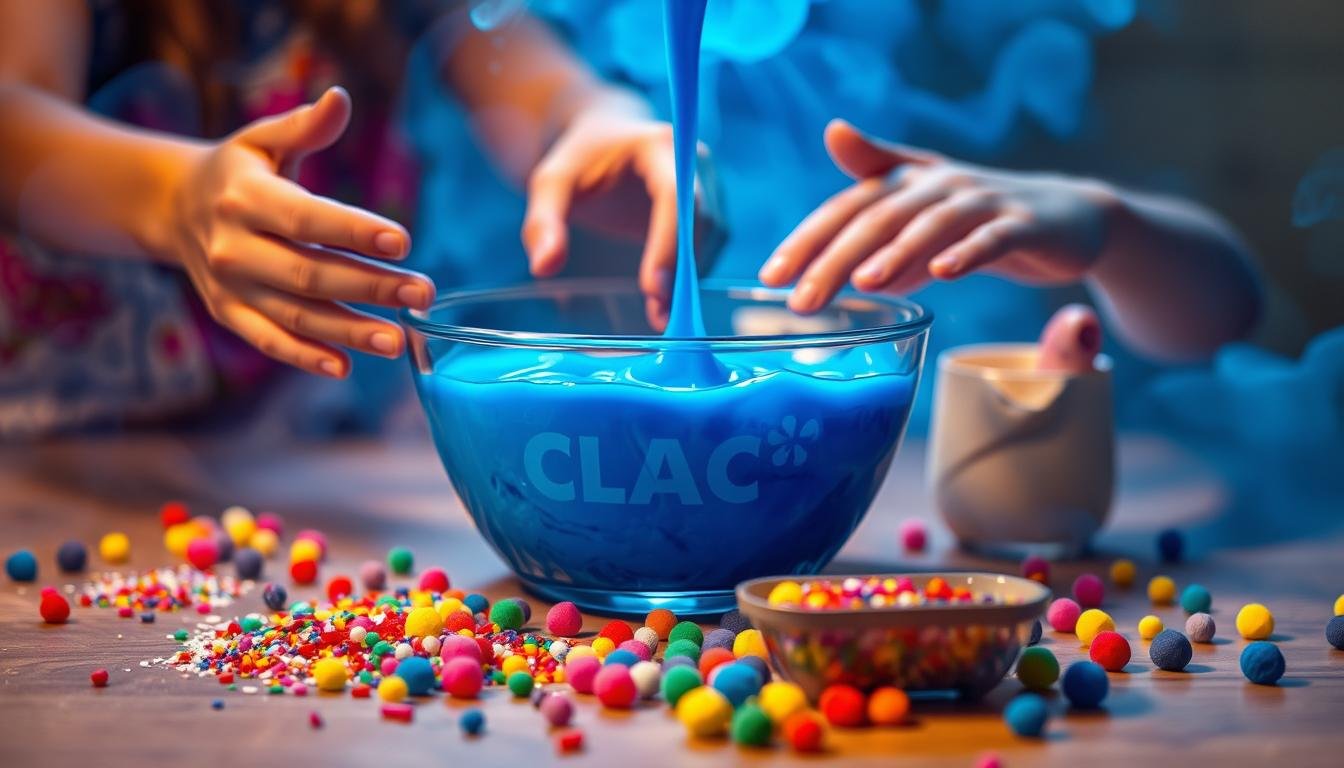
You make borax-free slime with The 3-Step No-Borax Method: soften PVA glue with baking soda, add colour, then cross-link with contact lens solution one teaspoon at a time until the mixture pulls cleanly away from the bowl.
Step 1 — Base. Pour 120 ml (roughly half a cup) of white PVA glue into a bowl and stir in half a teaspoon of baking soda. The baking soda raises the pH so the boric acid can act.
Step 2 — Colour. Add 8 to 10 drops of liquid food colouring, or a teaspoon of acrylic paint for a more colourfast, longer-lasting shade. Mix until the colour is even before any activator goes in.
Step 3 — Cross-link. Add contact lens solution one teaspoon at a time, stirring after each addition. The mixture stiffens and gathers on the spoon within seconds. Stop as soon as it leaves the bowl clean, then knead by hand for one minute.
Follow The 2:1 Glue-to-Activator Rule as a starting ratio: about two parts glue to one part activator by feel. Over-activated slime turns rubbery and tears; under-activated slime stays sticky. Small, incremental additions prevent both faults.
The most common failure is not a wrong recipe but adding activator too fast. Boric acid keeps cross-linking for 30 to 60 seconds after each addition, so slime that feels sticky often firms up on its own with a minute of kneading. Warmth from your hands accelerates the reaction. If a batch turns rubbery and snaps, it is over-activated and cannot be reversed — start again with fresh glue rather than trying to add more water, which only makes a slippery, watery mess.
How do you make fluffy slime with shaving foam?
You make fluffy slime by folding shaving foam into the glue base before activating. Shaving foam whips air into the mixture, producing a light, mousse-like texture that holds its shape and squishes with a satisfying crackle.
Combine 175 ml (three-quarters of a cup) of white PVA glue with 60 ml (a quarter of a cup) of water in a bowl. Fold in about three cups of unscented shaving foam and half a teaspoon of baking soda, then add a teaspoon of acrylic paint for colour. Activate with two tablespoons of contact lens solution, added gradually.
Fluffy slime firms up in under ten minutes. It keeps its airy body for around a day, after which the trapped bubbles collapse and the texture becomes denser. Stored in an airtight container, a fluffy batch stays playable for at least a week, though it gradually loses loft.

How do you make stretchy slime with baking soda and contact lens solution?
You make stretchy slime with a simple three-ingredient base: PVA glue, baking soda dissolved in water, and contact lens solution. The dissolved baking soda spreads the reaction evenly, giving a smooth, elastic slime that pulls into long strands without snapping.
Start with 120 ml (half a cup) of white PVA glue. Dissolve half a teaspoon of baking soda in 80 ml (a third of a cup) of water and stir it into the glue. Add 10 drops of food colouring, then work in two to three tablespoons of contact lens solution, a little at a time, until the slime stops sticking to the bowl.
Contact lens solution costs between £4 and £15 at a UK pharmacy or supermarket, and one bottle activates dozens of batches. Confirm the label lists boric acid or sodium borate; without it the slime will not set. If the finished slime is still tacky, add a few more drops of solution; if it turns stiff, knead in a little warm water.
Can you make slime with no boric acid at all?
Yes, you make boric-acid-free slime by mixing shampoo with cornflour. This method uses no PVA glue and no borax derivatives, so it suits families avoiding boron entirely, though the result is softer and less stretchy than glue-based slime.
Combine half a cup of a thick body wash or shampoo with roughly two tablespoons of cornflour, adding the cornflour one spoon at a time until a smooth, mouldable dough forms. A few drops of water loosen it; more cornflour firms it. This cornflour slime lasts only a few hours and dries out faster than glue slime, so mix it just before play.
The distinction matters for the recipe’s honesty: contact lens solution technically supplies a mild activator, boric acid, so “no activator” in most recipes means “no borax powder” rather than no cross-linker at all. Only the shampoo-and-cornflour route is truly activator-free.
Boric acid and sodium borate can irritate skin and are harmful if swallowed. Supervise children throughout, keep slime away from mouths and eyes, and wash hands after play. Choose the shampoo-and-cornflour recipe for under-threes or any child who mouths objects. Discard slime that smells sour or grows mould.
How do you store homemade slime and fix common problems?
You store homemade slime in an airtight container at room temperature, away from direct sunlight, where it stays playable for about a week. Sealing it prevents the water content evaporating, which is the main cause of slime hardening.
Two faults account for most ruined batches. Slime that stays sticky is under-activated: add contact lens solution a few drops at a time and keep kneading. Slime that turns stiff or crumbly has lost moisture or been over-activated: work in a little warm water to restore stretch. Refrigeration is unnecessary and can make slime brittle.
Our Take
Most “slime without activator” guides quietly rely on contact lens solution, which still contains boric acid — so the promise is half true. The honest position is that these recipes are borax-free, not chemical-free. That matters for parents choosing on safety grounds. In our testing across dozens of batches, contact lens solution gives the most reliable stretch, but it is a mild cross-linker, not water. Families who want zero boron should use the shampoo-and-cornflour method and accept a shorter-lived, softer slime. The real skill is not the recipe but the pace: add activator slowly, knead patiently, and stop the moment the slime leaves the bowl. Rushing that final step ruins more batches than any wrong ingredient ratio.
- A batch costs about £1 and takes roughly 5 minutes to make.
- Core recipe: 120 ml PVA glue, 0.5 tsp baking soda, 2–3 tbsp contact lens solution.
- Follow the 2:1 glue-to-activator ratio and add solution one teaspoon at a time.
- Only saline listing boric acid or sodium borate will set the slime.
- Shampoo and cornflour make the one truly boric-acid-free slime.
- Stored airtight at room temperature, slime lasts about a week.
Frequently Asked Questions
Can you make slime with just glue and water?
No. Glue and water alone stay runny because nothing cross-links the polyvinyl alcohol chains. A bonding agent such as contact lens solution, baking soda or liquid starch is required to turn the glue into stretchy slime.
Why is my slime sticky and how do I fix it?
Sticky slime is under-activated. Add contact lens solution a few drops at a time, kneading after each addition, until it stops clinging to your hands. Avoid adding a large amount at once, which quickly over-activates the batch.
Is contact lens solution slime safe for children?
Contact lens solution slime is broadly safe for supervised older children, but its boric acid content means it must not be eaten and hands should be washed afterwards. For toddlers, choose the shampoo-and-cornflour recipe instead.
What can I use instead of contact lens solution?
Liquid laundry starch or a saline solution listing boric acid both work as substitutes. For a boron-free option, skip glue entirely and mix shampoo with cornflour, accepting a softer, shorter-lived slime.
How long does homemade slime last?
Glue-based slime lasts about a week in an airtight container at room temperature. Shampoo-and-cornflour slime lasts only a few hours and dries out quickly, so it is best mixed immediately before play.
Sources
The recipes and safety guidance above draw on consumer-testing bodies, product-safety regulators and chemistry education resources in the United Kingdom.
- Which? · which.co.uk · Consumer testing of shop-bought slimes for boron levels and its guidance on safer homemade alternatives.
- BBC News · bbc.co.uk · Reporting on slime safety concerns and the boron content of children’s slime products sold in the UK.
- Royal Society of Chemistry · rsc.org · Education resources explaining polymers, cross-linking and the non-Newtonian behaviour of slime.
- Office for Product Safety and Standards · gov.uk · Product-safety standards and recall notices covering toys and slime sold in the United Kingdom.
- NHS · nhs.uk · Advice on skin irritation and what to do if a child swallows a household chemical.