
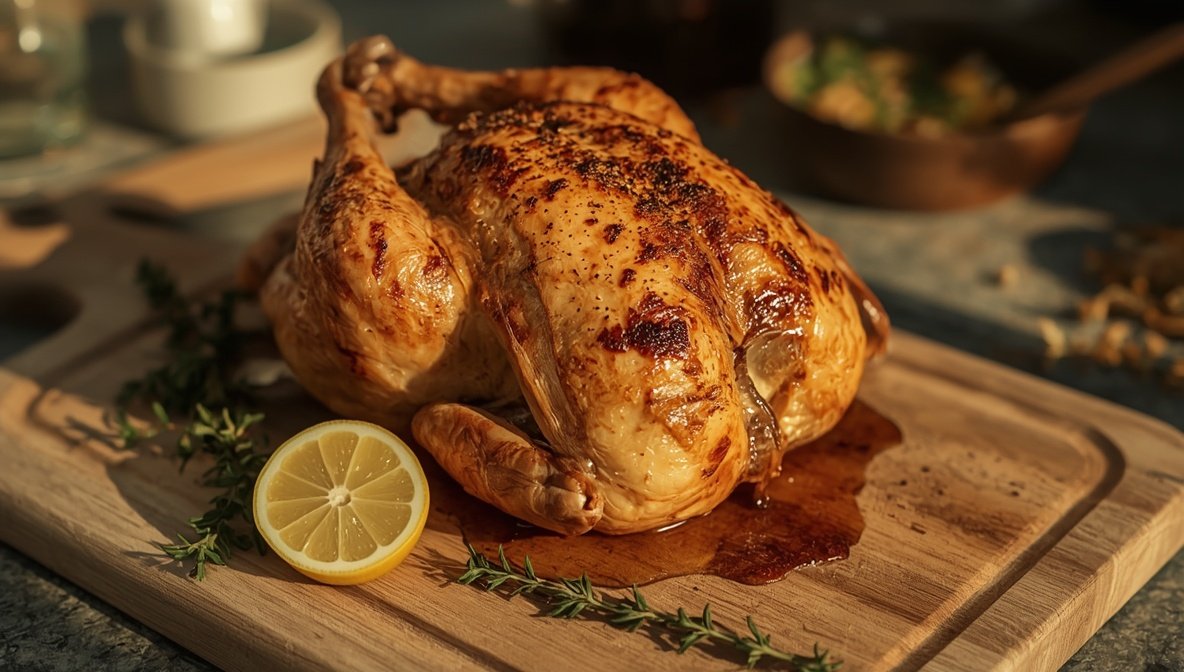
A whole roast chicken needs 20 minutes per 450g plus an extra 20 minutes at 200°C fan (220°C conventional), then a 15-minute rest. A standard 1.5kg bird takes about 1 hour 20 minutes; the safe internal temperature at the thickest part of the thigh is 75°C.
Quick Answer
Roast at 200°C fan (220°C conventional) for 20 minutes per 450g plus 20 minutes extra. A 1.5kg chicken cooks in roughly 1 hour 20 minutes; a 2kg bird in about 1 hour 50 minutes. Always check the thigh reaches 75°C on a digital probe, then rest the bird uncovered for 15 minutes before carving so the juices redistribute.
How long does a roast chicken take per kg?
A roast chicken takes approximately 45 minutes per kilogram plus 20 minutes extra at 200°C fan. A 1.6kg bird therefore needs around 1 hour 32 minutes; the exact minute matters less than the internal temperature, which must reach 75°C at the thickest point of the thigh before serving.
Standard cooking times by weight
- 1.2kg chicken: approximately 1 hour 5 minutes
- 1.5kg chicken: approximately 1 hour 20 minutes
- 1.8kg chicken: approximately 1 hour 40 minutes
- 2kg chicken: approximately 1 hour 50 minutes
- 2.5kg chicken: approximately 2 hours 15 minutes
These figures assume a fan oven at 200°C. If you are using a conventional oven, set it 20°C higher at 220°C but keep the same timings. Ovens vary; a cheap oven thermometer sitting on the middle shelf is the single best investment for consistent Sunday lunches.
What temperature should the oven be for roast chicken?
The Food Standards Agency and most British chefs recommend cooking whole chicken at 200°C fan or 220°C conventional. Higher heat crisps the skin and speeds cooking without drying the meat, provided you cover the breast loosely with foil for the first 45 minutes on larger birds.
Two-stage roasting for crispier skin
For deeply golden skin, blast the chicken at 220°C fan for the first 15 minutes, then drop the temperature to 180°C fan for the remainder of the cook. Add an extra 10 minutes to the total time when using this method. The initial burst renders the fat under the skin while the gentler heat prevents the breast from tightening.
How do I know when a roast chicken is cooked?
A roast chicken is safely cooked when a digital probe inserted into the thickest part of the thigh, not touching bone, reads 75°C or higher. The juices should run clear when the thigh is pierced with a skewer, and the leg should feel loose when wiggled gently.
Expert Insight
“Colour is not a reliable indicator of doneness in poultry, and neither is time alone. A £10 digital probe thermometer will save you from both undercooked chicken and dry, over-cooked breast meat. Take the bird out at 72°C in the thigh; carry-over heat during resting will lift it to 75°C, which is the temperature the FSA sets to eliminate campylobacter and salmonella risk.”
Should you cover a roast chicken with foil?
Cover a roast chicken loosely with foil for the first two-thirds of the cook if the bird is over 1.8kg, then remove for the final 30 minutes to brown the skin. Smaller birds under 1.5kg brown evenly without foil and rarely need it, especially in a fan oven.
Why rest a roast chicken before carving?
Resting a roast chicken for 15 minutes allows the muscle fibres to relax and reabsorb the juices that were driven to the centre by heat. Carving straight from the oven loses up to a third of the juice onto the board, leaving the meat noticeably drier and the gravy diluted.
How to rest properly
Lift the bird out of the roasting tin, transfer to a warm plate or board, and tent loosely with foil. Do not seal the foil down or the skin will soften. Fifteen minutes for a 1.5kg chicken, twenty for anything over 2kg. Use the resting time to finish potatoes, make gravy and steam greens.
How long to cook a roast chicken in a fan oven?
In a fan oven set to 200°C, a whole roast chicken needs 20 minutes per 450g plus 20 minutes extra. The circulating air cooks the bird 15 to 20 per cent faster than a conventional oven, so check with a probe from about the 55-minute mark on a 1.5kg bird to avoid overcooking.
Can you cook a chicken from frozen?
Do not roast a whole chicken from frozen. The FSA advises defrosting whole poultry thoroughly in the fridge, allowing roughly 10 to 12 hours per kilogram, so a 1.5kg bird needs at least 16 hours. Cooking from frozen risks the inside failing to reach 75°C while the outside overcooks.
Our Take
Weighing the bird before it goes in the oven is the single most useful habit in Sunday cooking. Supermarket labels round up; a “1.5kg” chicken on the packet often weighs 1.35kg or 1.62kg. Two minutes on the kitchen scales gives you a real cooking time, and a probe thermometer confirms it. That is the whole trick — the rest is just seasoning and patience.
What is the best way to season a roast chicken?
Rub the skin generously with softened butter and season with 1 teaspoon of fine salt per kilogram before roasting. Push half a lemon and a few sprigs of thyme into the cavity. Salting the skin an hour before, if time allows, draws out surface moisture and gives a crisper finish.
Simple flavour combinations
Butter, lemon, thyme and garlic is the British classic. For variation, try smoked paprika and softened butter for a paprika chicken; olive oil, rosemary and lemon zest for a Mediterranean profile; or a compound butter of grated Parmesan and cracked black pepper pushed under the breast skin. Never season the cavity heavily — the flavour barely penetrates the meat.
How do you carve a whole roast chicken?
Remove the legs first by cutting through the joint where the thigh meets the body. Separate drumstick from thigh at the knee. Slice down along the breastbone on each side, releasing the breast in one piece, then carve across the grain into 1cm slices for the plate.
Key Takeaways
- Roast at 200°C fan / 220°C conventional for 20 minutes per 450g plus 20 minutes extra.
- A 1.5kg chicken takes approximately 1 hour 20 minutes; a 2kg bird approximately 1 hour 50 minutes.
- The safe internal temperature at the thickest part of the thigh is 75°C, per FSA guidance.
- Rest for 15 minutes for a 1.5kg bird, 20 minutes for anything over 2kg.
- Never roast a whole chicken from frozen — defrost 10 to 12 hours per kilogram in the fridge.
- A £10 digital probe thermometer is the single biggest upgrade to your Sunday roast.
Once the chicken is out and resting, use the resting time productively. If gammon is on the menu next week, our guide to the Oven-Baked Gammon Joint: No-Boil Method follows the same weigh-then-probe principle, and roasting fat from the chicken tin can be spooned over the potatoes for extra flavour.
Frequently Asked Questions
Can I roast a chicken breast-side down?
Yes. Roasting breast-side down for the first 30 minutes then flipping the bird keeps the breast meat moist because the juices from the legs run down into it. The skin on the breast will be less crisp, so this method suits gravy-heavy Sunday lunches rather than plates where crackling skin matters.
What if my chicken is still pink at the joint after cooking?
Pink flesh near the bone in a bird that has hit 75°C in the thigh is safe — the discolouration is caused by myoglobin in the bone leaching out, not undercooking. Return the bird to the oven only if the probe temperature is below 75°C, not because of colour alone.
Do I need to wash a chicken before roasting?
No. The FSA and NHS both advise against washing raw chicken because splashing water spreads campylobacter bacteria around the kitchen. Cooking to 75°C destroys the bacteria; washing simply moves them onto worktops, hands and other food.
How long does leftover roast chicken keep in the fridge?
Cooked chicken keeps for up to two days in a covered container in the fridge at 5°C or below. Cool it within one hour of cooking, refrigerate promptly, and reheat leftovers only once, ensuring they are piping hot throughout — again, a probe reading of 75°C is the standard.
Can I use the roasting tin juices for gravy?
Yes, and you should. Pour off most of the fat, keeping the dark caramelised juices at the bottom of the tin. Deglaze on the hob with a splash of white wine or chicken stock, scrape up the fond, add a teaspoon of flour, whisk and simmer for two minutes. This is the best gravy you will ever make.
Sources
- Food Standards Agency — Cooking your food: chicken and other poultry. Cooking temperature guidance (75°C at the thickest point).
- NHS — Food safety at home. Guidance against washing raw chicken.
- BBC Good Food — How to roast a chicken. Standard British roasting method (20 min per 450g plus 20 min at 200°C fan).
- Which? — How to defrost chicken safely. Defrosting time of 10 to 12 hours per kilogram in the fridge.