
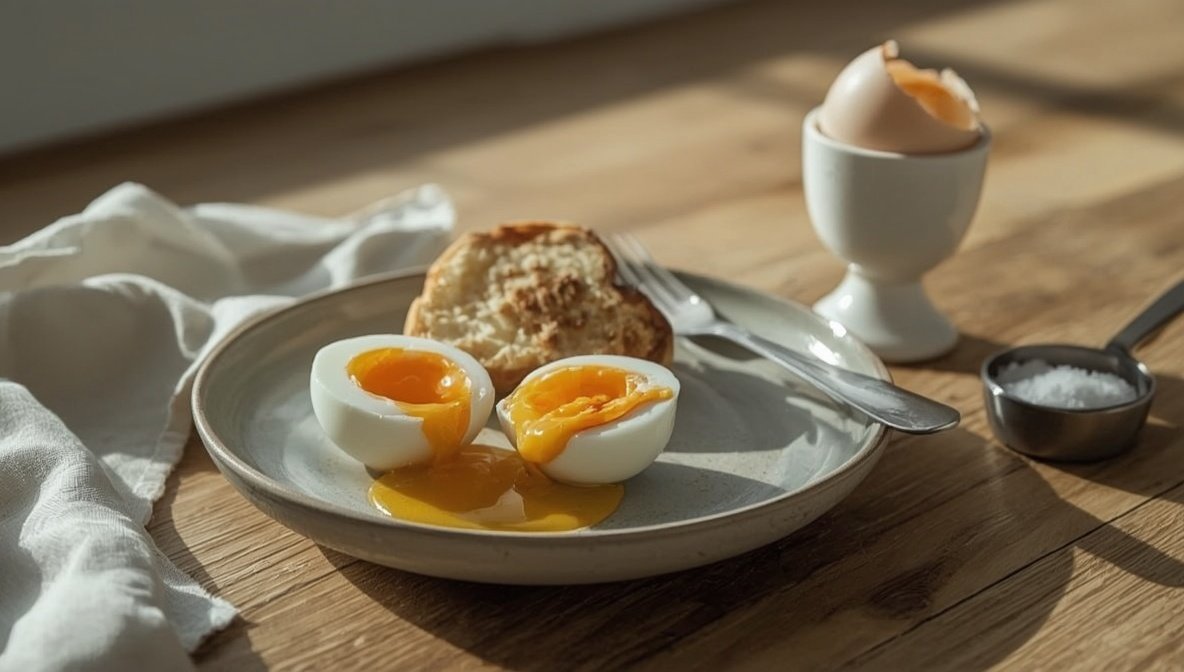
Boil a large egg (about 60 g) straight from the fridge in already-simmering water: 6 minutes for a runny yolk, 7 minutes for a jammy centre, 8 minutes for soft-set, and 10 minutes for hard-boiled. Time from the moment the egg enters the water, and stop cooking with cold water.
Quick Answer
Bring water to a simmer, lower the egg in on a slotted spoon and time from that moment: 6 minutes for runny (dippy) yolk, 7 minutes for jammy, 8 minutes for soft-set, 10 minutes for hard-boiled. Plunge into cold water for 60 seconds when the timer goes off. Times are for a large egg (about 60 g) fridge-cold.
How long does a boiled egg take?
A fridge-cold large egg lowered into gently simmering water takes 6 minutes for a soft, runny yolk suitable for dipping soldiers into. Seven minutes gives a jammy, sticky yolk favoured for ramen or a good egg mayo. Eight minutes gives a soft-set yolk with a slight wobble, and 10 minutes gives a fully hard-boiled egg with a pale, crumbly yolk suitable for picnics or salads.
These timings assume a large egg (Lion-mark large is roughly 63–73 g in the UK), water at a gentle simmer (not a rolling boil), and the egg going straight from the fridge into the pan. Medium eggs shave about 30 seconds off each stage.
Should you start with cold or boiling water?
Start with boiling water. Lowering a cold egg into simmering water gives a predictable, repeatable timing and stops the white from turning rubbery. The cold-start method — putting eggs into cold water and bringing it to the boil — is harder to time because your hob’s heat output changes the total cooking time.
Boiling water also produces a smaller cooked white and a more centred yolk, because the egg protein sets on contact rather than shifting as the water warms.
Do you need to prick the shell?
Pricking the wide (blunt) end of the shell with a pin releases the small air pocket inside and reduces the risk of cracking as the egg heats. It also makes peeling easier for hard-boiled eggs. It is optional for soft-boiled eggs, but takes 3 seconds and rarely does harm.
The Food Standards Agency (food.gov.uk) confirms that this technique does not affect food safety, and doesn’t interfere with the safety of British Lion-mark eggs, which are salmonella-controlled at the farm level.
Expert Insight — Eleanor Hayes, home-food editor
The trick nobody mentions is water depth. Eggs need at least 3 cm of water above them, because the temperature drops the second cold eggs go in. A shallow pan of water cools too much and your 7-minute jammy egg comes out at 5 minutes-worth of cooking. Use a saucepan, not a milk pan.
What’s the difference between soft-boiled and hard-boiled?
A soft-boiled egg has a set white and a liquid or jammy yolk — the classic egg-and-soldiers finish, generally 6 to 8 minutes. A hard-boiled egg has a firm white and a fully solid yolk suitable for slicing, chopping into salads, or curried egg sandwiches, generally 10 minutes.
Overcooking a hard-boiled egg (12 minutes or more) forms a grey-green ring around the yolk. That ring is iron sulphide, harmless but a sign of over-boiling and a slightly sulphurous taste. Ten minutes is the sweet spot for a hard-boiled egg with no ring.
How do you stop them from cracking?
Cracking happens when the shell can’t withstand the pressure of expanding air and steam inside. Three things reduce it: prick the wide end with a pin, lower the egg gently on a slotted spoon rather than dropping it, and keep the water at a bare simmer rather than a rolling boil. If your eggs still crack, add a teaspoon of white vinegar to the water — it helps coagulate any leaking white almost instantly and stops the crack from widening.
Why are boiled eggs so hard to peel?
Fresh eggs (under a week old) are notoriously hard to peel because the pH of the white is still low, and it clings to the inner membrane. Eggs 7 to 10 days old peel cleanly. This is why hard-boiled eggs at a Sunday buffet often use eggs that were bought last weekend.
To help peeling regardless of age, plunge cooked eggs into a bowl of iced water for at least 5 minutes. The rapid cooling shrinks the white slightly away from the shell. Then tap the wide end, roll on the worktop to craze the shell, and peel under a trickle of cold water.
Are boiled eggs safe to eat?
Yes. Eggs bearing the British Lion mark are safe to eat runny or raw for everyone including pregnant women, infants and elderly people, according to Food Standards Agency guidance updated in 2017 and reaffirmed since. Around 90% of UK eggs carry the Lion mark. Non-Lion eggs (imported or from very small producers) should be cooked until both white and yolk are firm.
Hard-boiled eggs in shell keep for up to 7 days in the fridge. Peeled hard-boiled eggs keep for 2 days, stored in a covered container.
Does altitude change the timing?
Only marginally at UK altitudes. Water boils at 100°C at sea level and about 99°C at 300 m elevation — Ben Nevis is 1,345 m, where water boils at 95.5°C. Home cooks in the Scottish Highlands may need to add 30 to 60 seconds to each stage; most of the UK sits below 100 m and can use the standard times unchanged.
Our Take
A digital kitchen timer is the difference between a perfect egg and a disappointing one. Mental counting is fine when you’re standing at the hob, but a phone timer set the moment the egg enters the water removes every source of error. The other free upgrade: buy your eggs mid-week, so that by Sunday brunch they’re a few days old and peel like a dream.
Key Takeaways
- Time from when the egg enters simmering water: 6 min runny, 7 min jammy, 8 min soft-set, 10 min hard-boiled.
- Assumes a fridge-cold large egg (about 60 g). Medium eggs need 30 seconds less at each stage.
- Water depth of at least 3 cm above the egg keeps the temperature stable when eggs go in.
- Iced water bath for 5 minutes stops cooking and makes peeling much easier.
- British Lion-mark eggs (about 90% of UK supply) are safe runny for all groups per FSA guidance.
- Hard-boiled eggs keep 7 days in shell in the fridge; 2 days once peeled.
Boiled eggs are perfect for a light supper, but if you’re building a fuller weekend meal, our guide to the Oven-Baked Gammon Joint: No-Boil Method shows how to produce sliced gammon and boiled-egg salad from one lazy Sunday.
Frequently Asked Questions
Can you boil eggs straight from the fridge?
Yes, and the timings above assume you do. Cold eggs are more likely to crack, so prick the wide end with a pin and lower gently with a slotted spoon. Room-temperature eggs need about 30 seconds less at each stage.
Why is my yolk green?
A grey-green ring around the yolk means the egg has been boiled too long — usually 12 minutes or more. It is iron sulphide, harmless but slightly sulphurous. Stick to 10 minutes for hard-boiled and cool immediately in iced water to stop the reaction.
How long do boiled eggs last in the fridge?
Hard-boiled eggs in shell keep for 7 days in the fridge. Peeled hard-boiled eggs keep for 2 days in a covered container. Soft-boiled eggs are best eaten straight away and not stored.
Can I boil eggs in a microwave?
No — not in shell. Microwaved eggs in shell explode because steam has nowhere to escape. If you want a hands-off method, an electric egg cooker or a steam basket over 1 cm of water on the hob (cover, steam 6–12 minutes) both work well.
Are older eggs really easier to peel?
Yes. Eggs 7 to 10 days old peel much more cleanly than very fresh ones, because the pH of the white rises with age and it stops clinging to the shell membrane. For picnic eggs, buy at the start of the week.
Sources
Food Standards Agency (food.gov.uk), egg safety guidance including the 2017 update on Lion-mark eggs. British Lion Eggs (egginfo.co.uk), production and standards data. BBC Good Food, boiled egg timing reference. NHS Eatwell Guide, eggs as a protein source. Which? kitchen timings tests. Royal Society of Chemistry, water boiling point at altitude.